As a veteran runner who broke 3:30 as early as 2017, I considered myself an experienced runner, and my goal was naturally to break three hours. However, from the very beginning, I knew this would be a difficult process requiring years of consistent, systematic training. Fortunately, through years of effort, I persevered. My performance improved time and again despite fluctuations, and I finally achieved my sub-3 goal on October 11, 2020.
Haruki Murakami, the Japanese author, wrote What I Talk About When I Talk About Running after more than thirty years of running. What did I do to break three hours in the marathon...
On the afternoon of October 11, 2020, I completed a full marathon test run, successfully finishing under three hours and achieving my sub-3 goal. Overwhelmed with excitement, I decided to write this summary to commemorate this significant milestone for any runner.
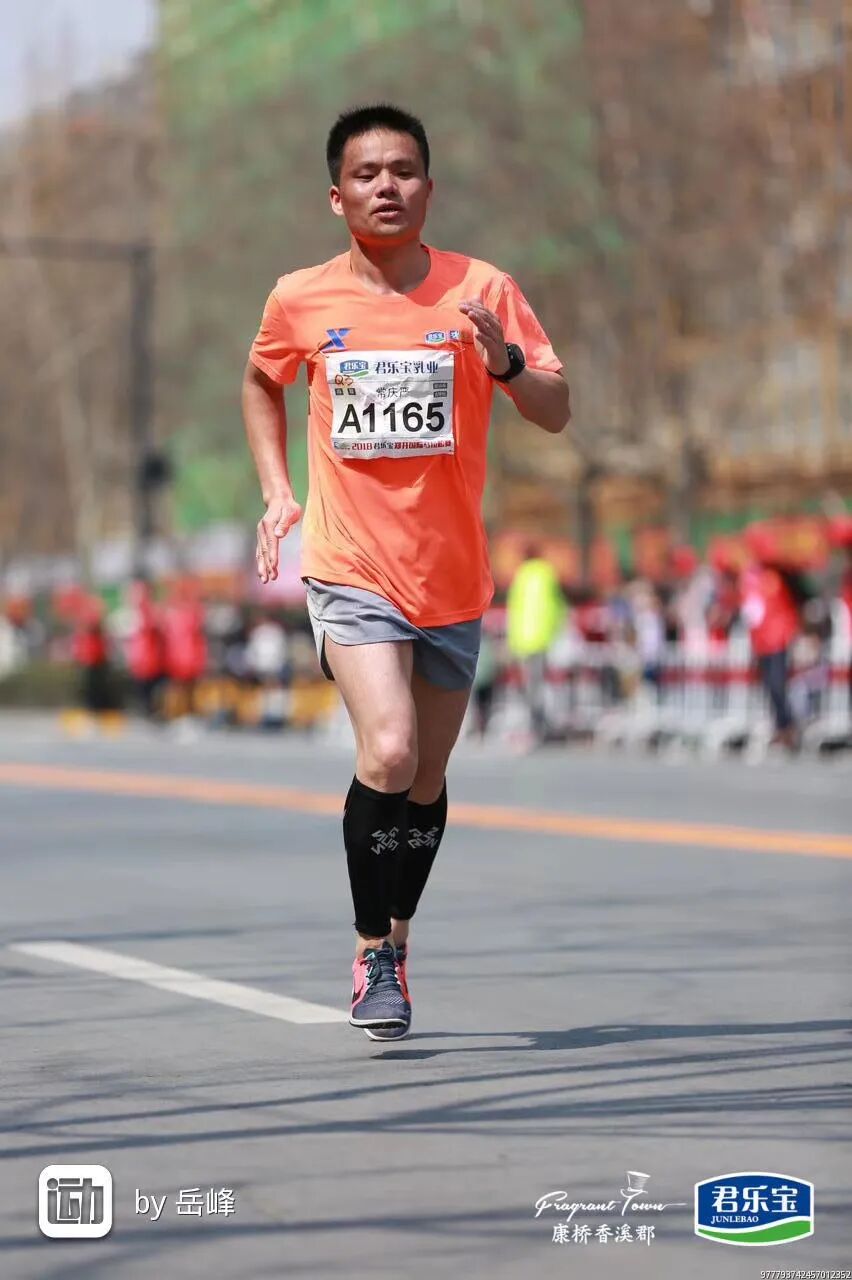
Breaking three hours—meaning completing a full marathon in under three hours (sub-3)—is the ultimate goal for many amateur runners, and a dream that most running enthusiasts will never achieve in their lifetime.
When I first started marathon training in 2017, it was said that fewer than 1,000 amateur runners in the entire country could finish a marathon in under three hours. The national second-tier athlete standard was merely 3:10. Most runners in Heze were aiming for 3:30, and achieving that time back then made you an absolute elite, starting in the A corral at most races and earning direct entry (without a lottery) to most events.
With the development of national fitness initiatives, society, government, and the country have invested more and more in sports and health. The public's enthusiasm for physical exercise has also grown. Running, as the simplest form of exercise, has developed rapidly. Running events of all sizes organized across the country have been growing several-fold every year, and more and more people have joined marathon training. It was only natural that the overall running level of the population would improve rapidly.
Eventually, the marathon second-tier athlete standard was raised to 2:53, and the elite standard was trending toward sub-3 as well. More and more runners were no longer satisfied with the old elite standard of 3:30, but were targeting the absolute elite standard of sub-3, or even the new national second-tier marathon athlete standard of 2:53.
As a veteran runner who broke 3:30 as early as 2017, I considered myself an experienced runner, and my goal was naturally to break three hours. However, from the very beginning, I knew this would be a difficult process requiring years of consistent, systematic training. Fortunately, through years of effort, I persevered. My performance improved time and again despite fluctuations, and I finally achieved my sub-3 goal on October 11, 2020.
Looking back at my marathon training journey, what did I do? What were the lessons learned, and what were the mistakes? If I could do it all over again, could I have done better? This summary is needed to promote my future training, and also as a way to reminisce about the past.
In the second half of 2017, after retiring from the military and returning to my hometown of Cao County, I happened to meet Brother Zhou Zhongtao and Zhu Fuxin at the People's Park. The three of us trained together and initially developed the idea of participating in marathon races. The idea was simple at the time—just to finish. Since I had run 5K in 19:20 during my time in the army, I quickly adapted to training distances of over ten kilometers. By August, I had self-tested a half marathon, finishing in about 1:50.
In October 2017, I participated in the 2nd Half Marathon organized by Huayang Real Estate in Heze City, finishing in about 1:34. In the following weeks, I self-tested several full marathons at Cao County People's Park, with a best of 3:23.
In November, I ran two full marathons: the 2017 Qingdao Marathon and the 2017 Jining Ring Taihu Lake Marathon, finishing in 3:23 and 3:26 respectively.
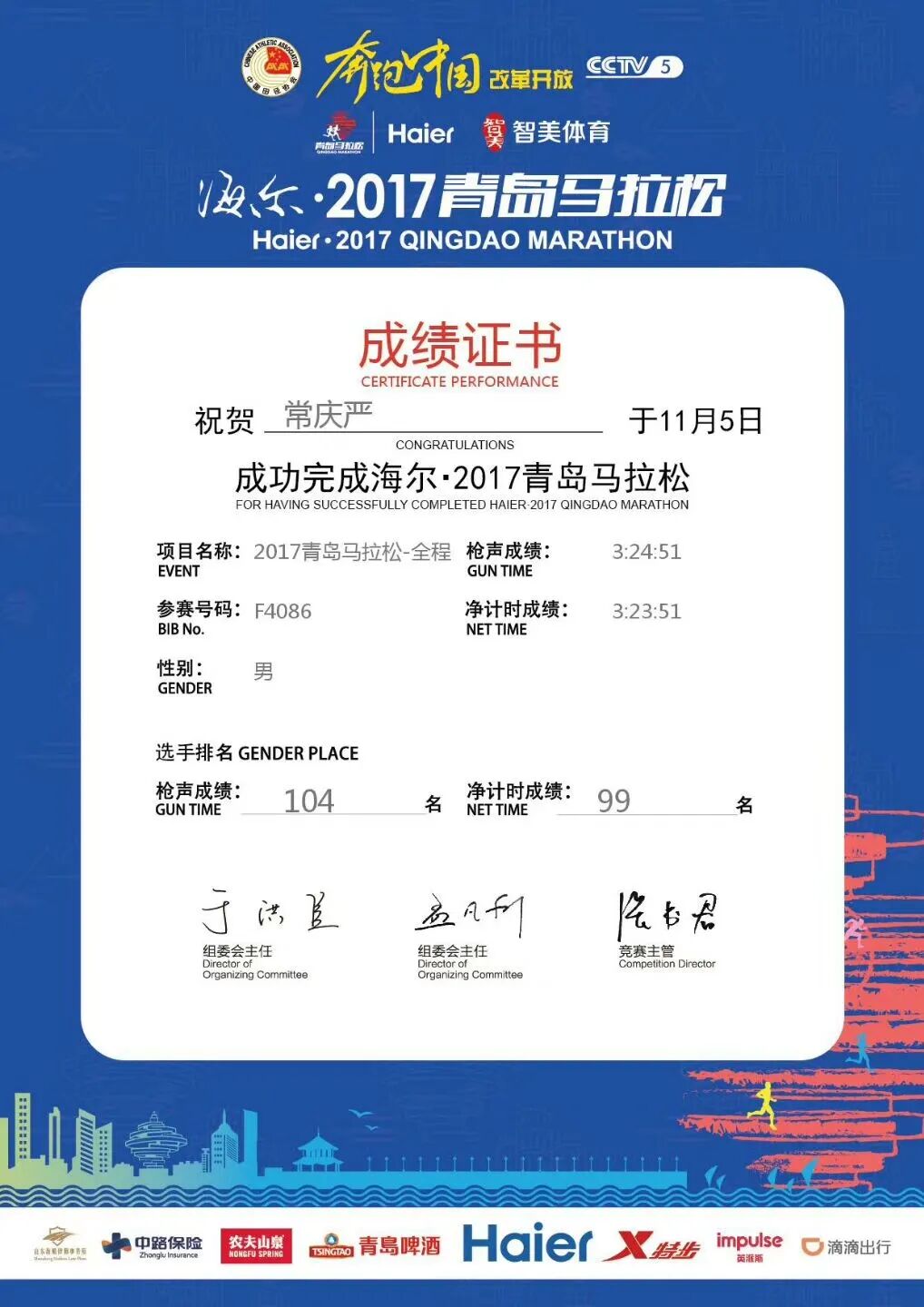
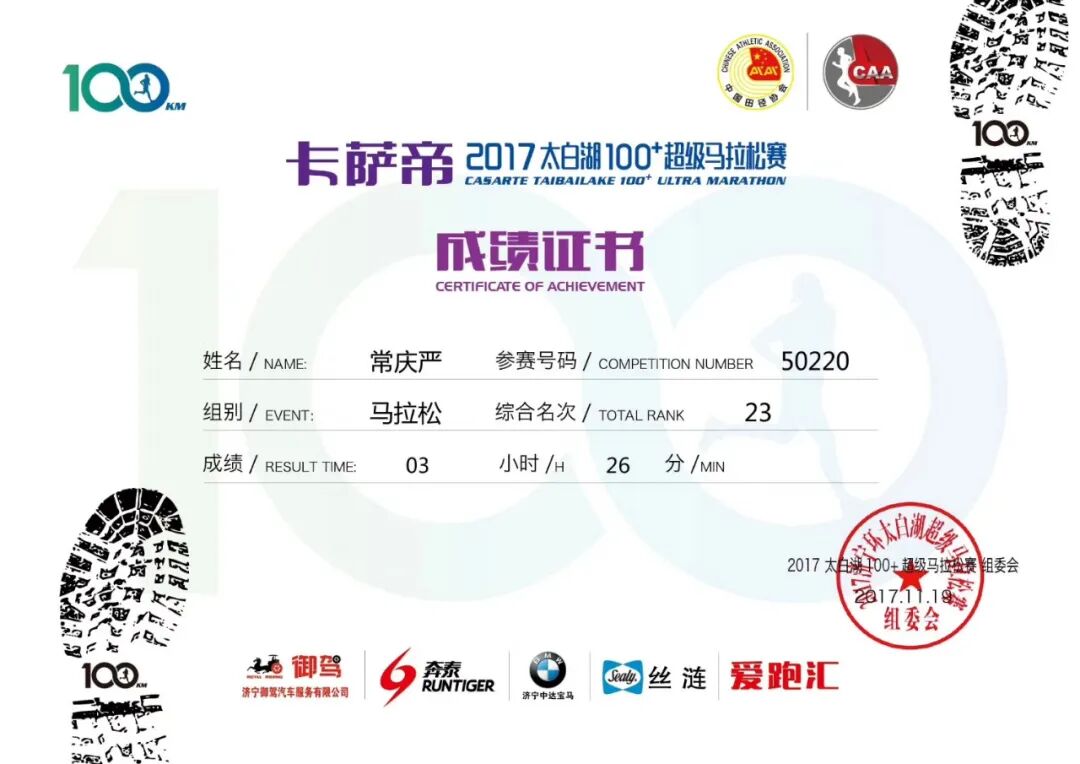
After that, I became obsessed with long-distance running. Almost every week I would run a loop around Heze City, with distances of at least 42 kilometers, often running over 50 kilometers.
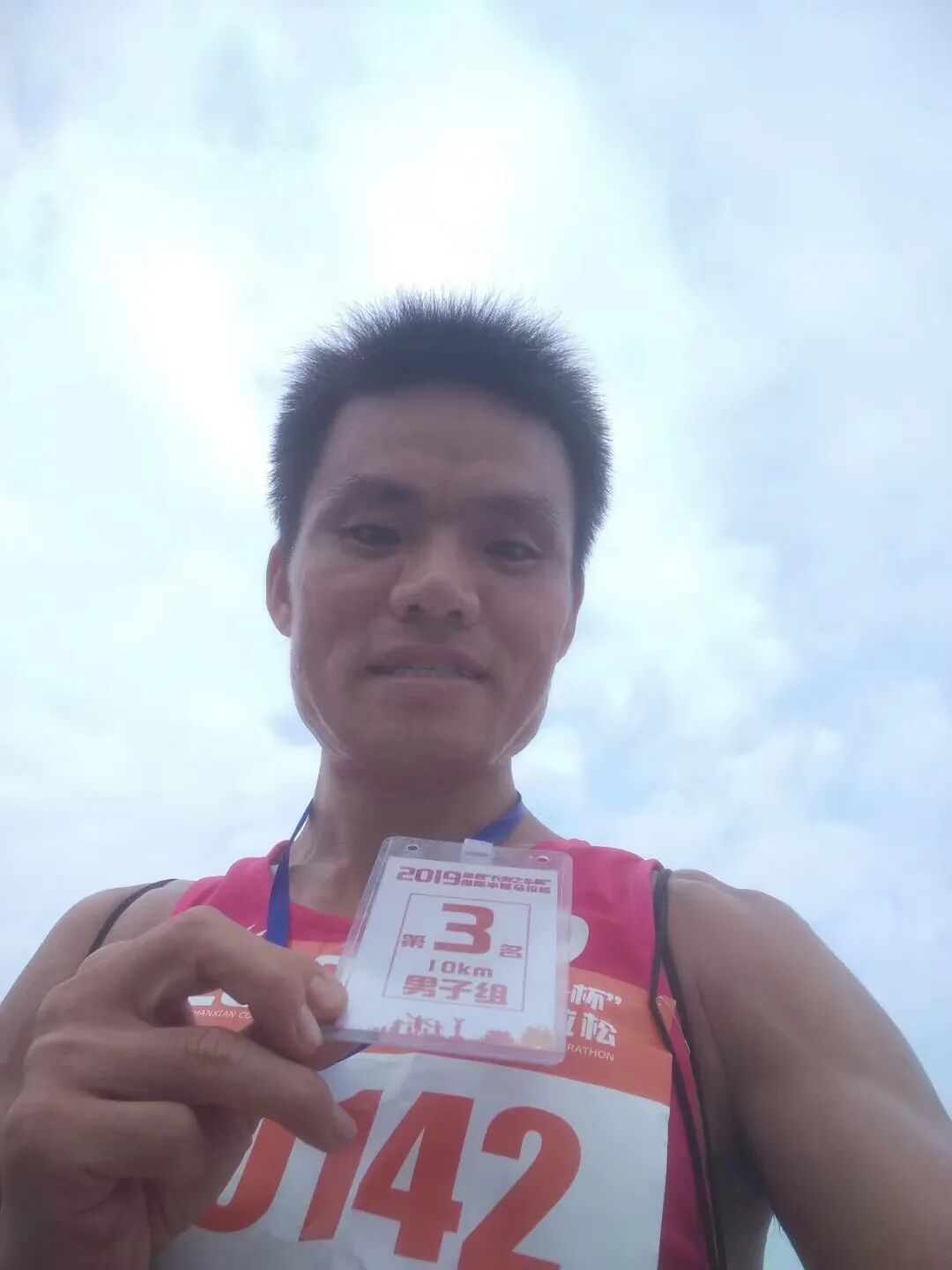
On January 14, 2018, I participated in a hiking competition organized by the Heze Municipal Government, with a course distance of about 12 kilometers. I actually won 3rd place. Standing on the podium, the director of the Municipal Sports Bureau shook my hand and said, "You are heroes of the city!" At that moment, I truly felt like I was something special.
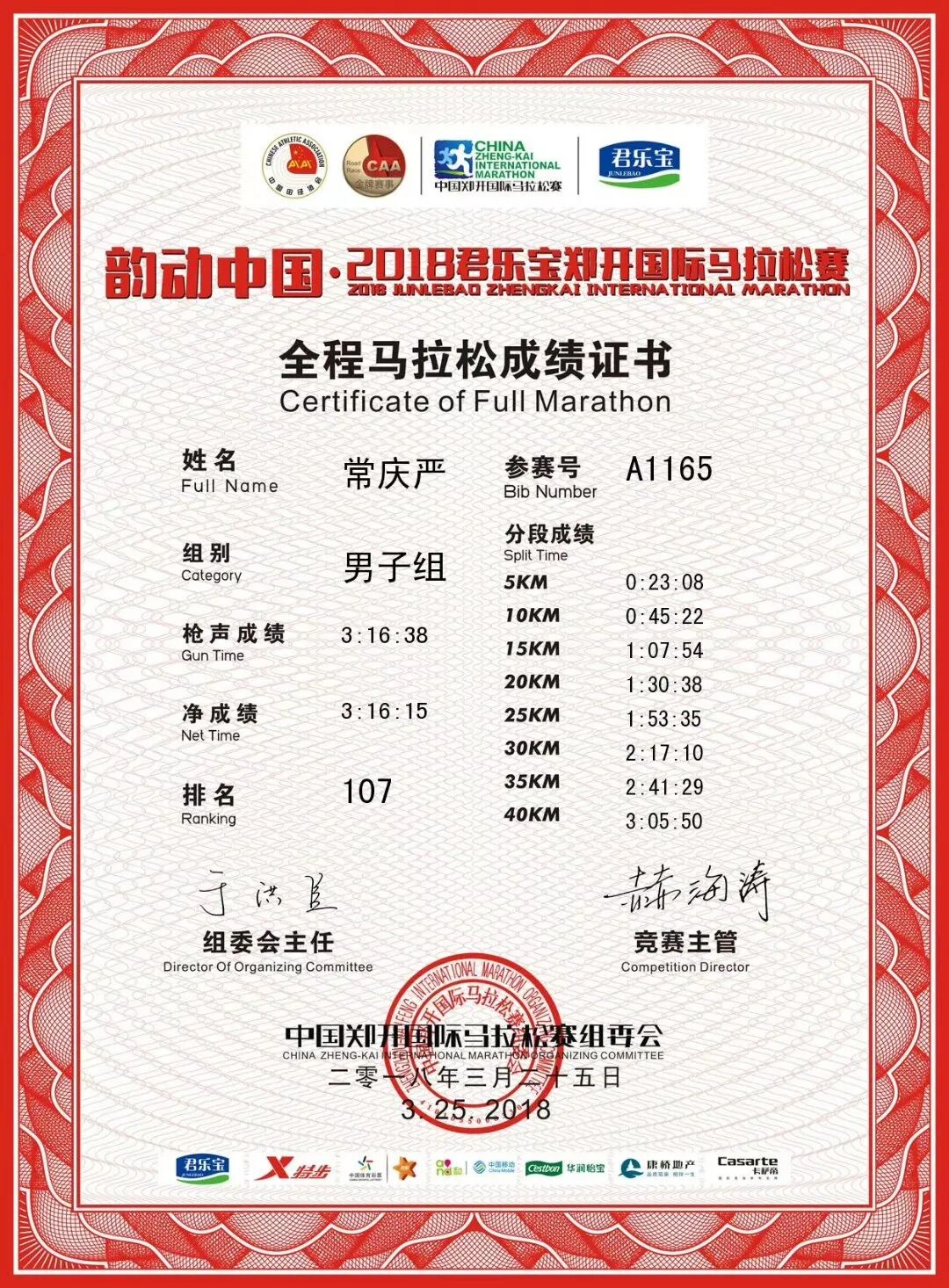
In 2018, I ran a few more races: the Heze Half Marathon in 1:29:58, the Zhengkai Marathon in March in 3:16, and the Rizhao Marathon in September in 3:15.

In November 2018, at the Dongming Marathon, I got a bit cocky. I was aiming to break the national second-tier marathon standard of 3:10, but I finished in 3:33, completely falling apart.
At the 2019 Heze Marathon, I attempted to break 3:10 again, but once again failed with a time of 3:22. In April 2019, at the Beijing Half Marathon, I set a new personal best of 1:27.
In the summer of 2019, I started trying interval training, and broke 40 minutes in a self-tested 10K.
I participated in the 2019 Wen Chang Lake Half Marathon. Although the course had significant elevation changes, I ran very steadily with an average pace of 4:09. Shortly after, I ran the Qihe Half Marathon in 1:27.
At the Shan County 10K race, I finished in 39:26. The organizers mistakenly gave me the 3rd place plaque, but it was later confirmed that I was 5th, missing my second chance to stand on the podium.
In November 2019, I participated in the Dongming Marathon and successfully broke the old national second-tier marathon standard with a time of 3:07.

Shortly after, I ran the Jinan Marathon and the Shanghai Marathon, but failed to make further breakthroughs, finishing in 3:16 and 3:18.
In the summer of 2019, I asked my friend Yu Xiangying to help me buy a pair of Adidas Takumi running shoes. For the first time, I wore genuine athletic shoes, and I realized that good equipment really could lead to more stable performance.
The experience of interval training also made me realize that different training methods could improve different specific abilities. Through a chance encounter, I joined the Wujiang Sub-3 Group, where I learned more running knowledge and saw the daily training of more elite runners. Weekly interval training, high-intensity tempo runs, and long slow distance runs became my running essentials.
On New Year's Day 2020, I set a new half marathon PB of 1:26 at the Liaocheng Half Marathon, and I also won entry to the Wuxi Marathon. Just as I was preparing for further breakthroughs, the COVID-19 pandemic turned my racing dreams into bubbles.
The originally planned 14-day closed-duty rotation model changed again and again, unpredictably causing me and my colleagues to be isolated from the world for over two months.
Just after the 2020 Spring Festival, as COVID-19 raged and Wuhan was locked down, the national prison duty model was uniformly changed to 14+N+N. As a young generation prison officer with ambition and a desire for progress, entering closed duty in the prison was a duty-bound responsibility. When the sudden pandemic emerged, everyone thought of the 2003 SARS outbreak, but its severity far exceeded everyone's imagination. Just as we had completed our 14-day closure and were preparing to rotate out, five prisons in three provinces—Hubei, Zhejiang, and Shandong—reported inmate infections, and the Ministry of Justice issued an order to stop rotations.
Clearly, our preparations for closed duty were insufficient. As a running enthusiast, I was a bit stunned. They say running is the simplest sport—all you need is a pair of shoes to start training. While that may be true, some equipment can make a big difference in getting a good experience. Of course, there are legendary runners like Chao Guorui from Yuncheng, who ran a 2:49 marathon PB in slippers, and was even caught on camera by CCTV running the Beijing Marathon in slippers. Major media outlets competed to interview and report on him, and the nickname "Slipper Brother of the Beijing Marathon" spread across the country.
On marathon courses, there are also many barefoot runners, and a few who run in suits and leather shoes. Some dress in imperial robes, while others cosplay as Sun Wukong or Zhu Bajie. These seemingly lighthearted marathon participants are actually incredibly capable elites—not something ordinary people can easily imitate.
As an ordinary running enthusiast, I still believe more in the power of technology. Eliud Kipchoge's sub-2 marathon attempt involved not only wearing thousands-of-dollars-per-pair Nike carbon-plated shoes, but also a pace car with laser guidance and eight pacers rotating to break the wind in groups.
The development of science and technology can undoubtedly help humans achieve breakthroughs—this is an indisputable fact.
However, I had not brought the equipment needed for systematic, structured running training for what was originally planned as a 14-day closed duty. I hadn't brought running shoes, quick-dry clothes, or even a running watch. Running for 30 minutes every few days in my duty shoes, winter police uniform, and peaked cap was my training routine.
As the rotation became more and more uncertain, I began to panic. I noticed that I had gained a lot of weight, which was unacceptable to me. In my mind, I was still that young man, not ready to become a greasy middle-aged man.

So, I restructured my training life during closed duty. I decided to start with easy running to lose weight. Once you stop training for too long, the process of restarting is always extremely painful. The biggest problem was ensuring training time, because with only one-third of the staff on closed duty, our workload was much heavier than normal. Moreover, it was wartime, with higher demands than usual, so naturally we had much less rest time. Night shifts were also longer and more frequent, and my mental state deteriorated every day.
But when you love something, nothing is a problem. I quickly resumed 10K runs, and after a few weeks of adjustment, running over 10 kilometers continuously became easier, but my pace was much slower. It was hard enough to break 4 minutes per kilometer, let alone break 40 minutes for 10K. In this state of resumed training under closed conditions, time passed a bit faster, my mentality gradually became more peaceful, and my fitness was sufficient to run over 20 kilometers continuously. But after every long run, my police uniform was completely soaked with sweat and then dried by the wind, with salt stains turning the dark blue into a mottled white.
Finally, the day of rotation arrived. A pair of duty shoes had been worn through with more than a dozen large holes, but they had successfully completed their mission, accompanying me through the most difficult time.
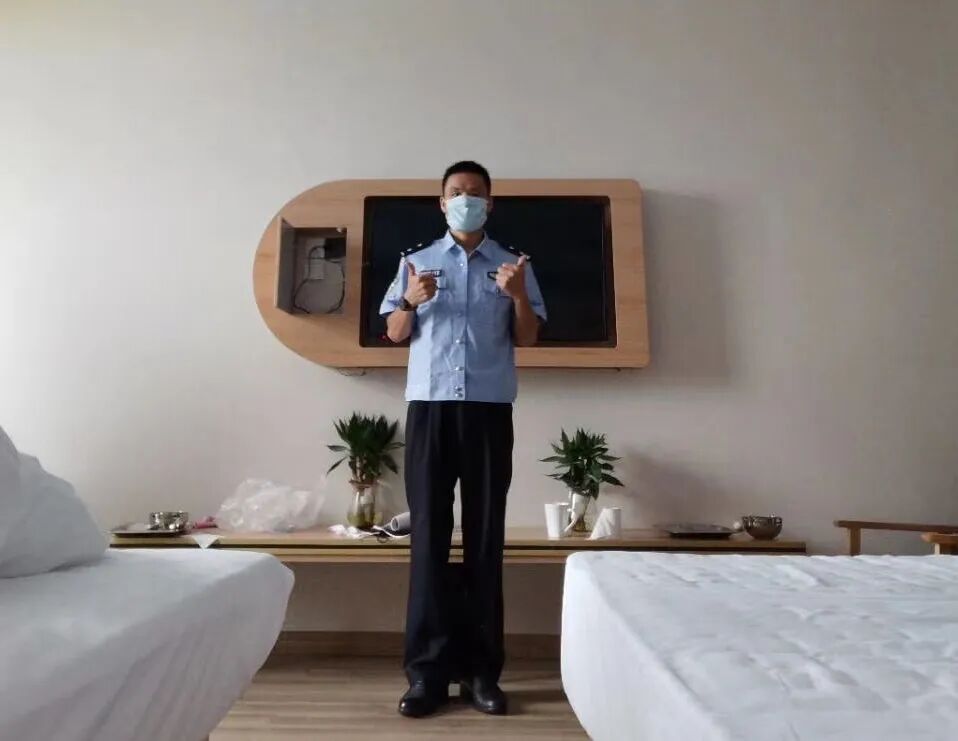
A month of rest at home passed in the blink of an eye. Bidding farewell to my wife and child, I began another long, grueling period of closed duty. First, 14 days of quarantine observation in a hotel where I couldn't run. I didn't dare to be idle—indoor shuttle runs, jogging in place, lunges, frog jumps, duck walks, and other leg-specific strength training kept me busy and happy every day.
However, this indoor training did not prevent the decline of my outdoor running ability. Once in the duty position, despite wearing running shoes, quick-dry clothes, and a smartwatch, simply running 10 kilometers produced alarmingly high heart rates. Only then did I understand that starting over was once again my only choice. With the experience of my previous difficult situation, I was much calmer this time. Interval runs, high-intensity tempo runs, long slow distance runs, and specific leg strength training filled all my rest time. Soon, a month passed, and another rotation came. After returning home, I did a 10K self-test and easily broke 39 minutes, which greatly exceeded my expectations, because this was a basic indicator for a sub-3 marathon. During my rest period at home, I also tested the half marathon, finishing in 1:27, which was not ideal. I understood that my training was not systematic enough; the lack of long runs over 30 kilometers meant my aerobic endurance did not match my running ability.
After several more rotations, as work resumed and production restarted, duty pressure grew heavier and work tasks became more demanding. But for me, running training was not only not difficult to maintain, but was the best remedy for relieving stress.
Running made me crazy and intoxicated. But indulging in running came at a certain cost. Frequent night shifts, heavy official duties to handle, and the little remaining time I had—I willfully increased my training time and intensity, eventually overdrafting my body. It sent a serious warning: a cold and fever slammed the brakes on my body, and all training had to stop.
With this lesson learned, I became more rational, recognizing that too much of anything is as bad as too little. The ultimate purpose of training is to make work and life more harmonious. Without excellent work and a comfortable life, training is meaningless. I reasonably set my training intensity to ensure I had enough energy every day to handle various affairs.
During another rest period at home between rotations, I tested the 10K in 38:22, and my confidence in breaking three grew even stronger.
I ran two 15K runs at a 4:00/km pace, both completed easily, with the last one breaking 59 minutes.
For long-distance training, I chose to measure by time: first easy 90-minute runs, then adapting to 2-hour runs, and finally running continuously for 2.5 hours without difficulty.
In terms of absolute speed and speed endurance, I also didn't slack off. Over the course of several weeks, I first did 200m intervals for 30 sets and 400m intervals for 20 sets at a pace of around 3:20/km, then 1000m intervals for 10 sets and 2000m intervals for 6 sets at a pace of around 3:30/km.
During this period, my 1000m runs often reached around 3:15, which again surprised me greatly. Because in the final physical education test of my first semester as a freshman in college in 2003, I ranked first in my college basketball class with a time of 3:20. In middle age, I had actually broken my own 1000m record set 17 years earlier when I was young.
I felt that the time had come to challenge the sub-3 marathon, scheduled for the morning of October 11, 2020. But life played another joke on me. On October 10, it was my turn on duty, and while transporting materials into the prison, I accidentally got one of my feet run over by the wheel of a flatbed cart. My toenail was bloody, and the arch of my foot seemed injured, aching dully. I thought it was over—not only would my planned marathon test be ruined, but I might have to stop training again. I even silently prayed in my heart, "Please don't leave me disabled." After all, that flatbed cart loaded with thousands of pounds of materials running over my foot—how could I not be desperate?
After resting for one night, my foot didn't swell, and moving it didn't cause too much discomfort, so I decided to postpone my marathon self-test to that afternoon.
After 2 p.m. on October 11, I began preparations. Because it was drizzling slightly, I didn't choose to wear a singlet but instead put on a quick-dry short-sleeve T-shirt, a pair of arm sleeves I liked, 1-inch racing shorts, towel-material marathon socks, calf sleeves, and Xtep 160X running shoes—a domestic marathon carbon-plated shoe that I had worn many times and found to be very stable. I prepared a bottle of pure water, mixed two packets of powdered sports drink Pocari Sweat into a glass of water, swallowed three energy gels, brought two more energy gels and two salt tablets, and headed to my self-test course.
This course was right outside the gate of my residential complex, totaling 2.17 km, with roads paved with asphalt within the last two years. I hid the water, powdered drink, salt tablets, and energy gels through a crack in the wall into a patch of ruins. I began my warm-up: 10 walking lunges, 10 squat jumps, 10 inner thigh stretches, 10 outer thigh stretches, 10 front kicks, then 30 butt kicks and 30 high knees for 2 sets each, and finally two 70m sprints. I set off, unhurriedly, at a 4:00/km pace for the first kilometer.
The first lap of 2.17 km was completed easily in under 9 minutes. The second lap was also completed steadily at a pace just over 4:00/km. After two laps, I reached through the wall crack, took out the pure water, and drank a big gulp—about a quarter of the bottle.
The third and fourth laps were still steady, also at a pace just over 4:00/km. I drank a sip of the powdered drink—about a third of a glass—sweet and refreshing, running with even more energy.
The fifth and sixth laps were still steady. After six laps, I reached through the wall crack, took out the two energy gels, and then tried to get the salt tablets, but I couldn't reach them. I had to lie completely on the ground, using my fingers to pull for a long time before I could touch them. By the time I finally got the salt tablets out from the wall crack, my arms were so tired they felt like cramping. I ate the two salt tablets and drank a quarter of the bottle of pure water. The pace for this kilometer showed over 5:00, but it didn't affect the big picture. The buffer time I had built up early on was enough to spare.
The seventh and eighth laps were still steady. I drank another big gulp of the powdered drink—still a third of a glass—and my body was reinvigorated.
At the halfway point, a little over 1:27—satisfying.
After 10 laps, I drank the last quarter of the pure water. My pace slowed slightly, but it was still within 4:15/km.
After 12 laps, I drank the last sip of the powdered drink, feeling relatively comfortable as I reached the 30K mark.
After 14 laps, I drank the last sip of pure water, lost all my support, but also felt no more burden. I just needed to push forward steadily, and success was certain.
However, the road to success was not comfortable. My thighs would occasionally feel tight—a precursor to cramping. I tried hard to adjust my running form, pushing myself forward as much as possible through mechanical inertia. My pace dropped a bit, but it was all within 4:30/km, perfectly acceptable. I endured through the 16th and 17th laps.
At the 18th and 19th laps, I continued to hold on, summoned by the happy call of success.
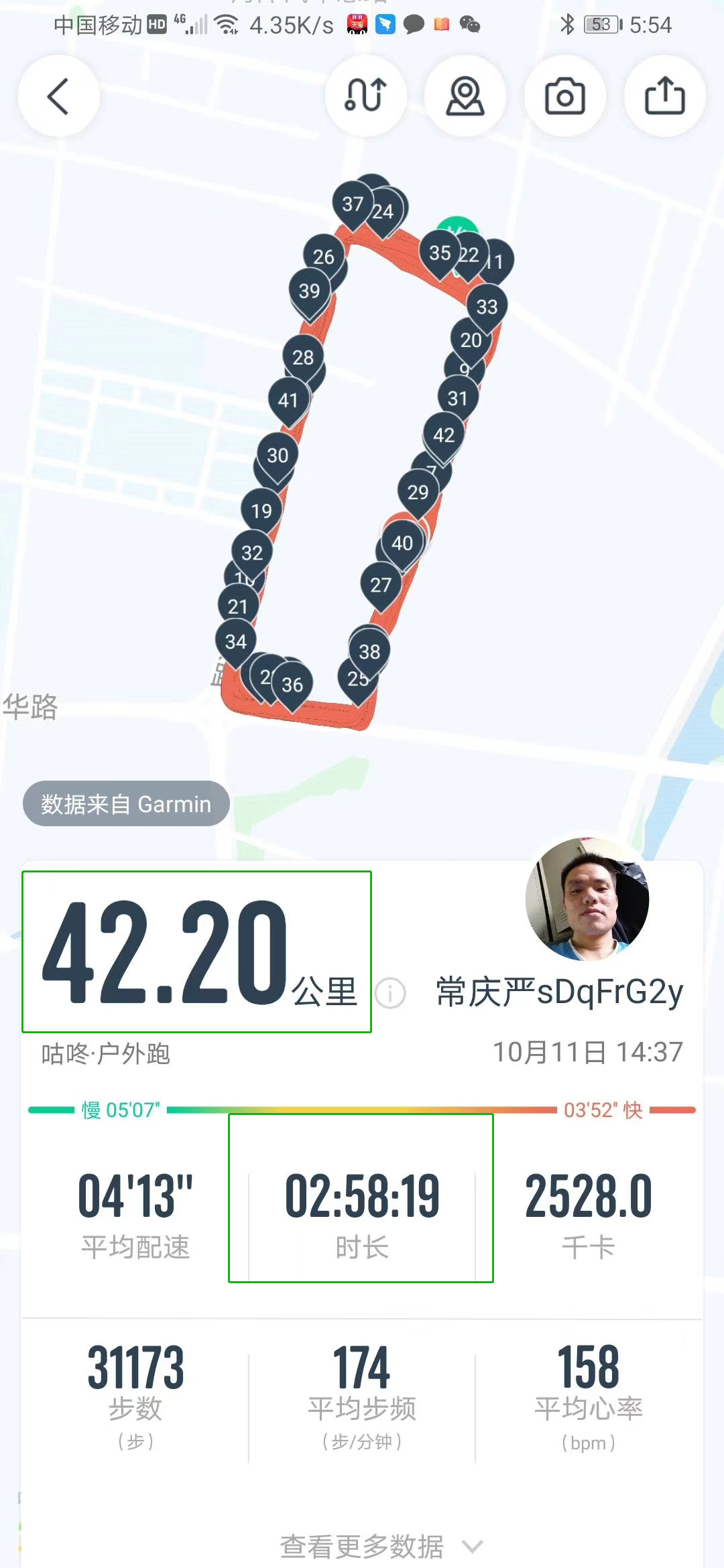
The final 1K acceleration was naturally a joyful release. At 42.20 km, I pressed the stop button on my watch: 2:58:20 gross time, 2:58:16 net time for the marathon. All the effort was worth it—my hard work had paid off.
From then on, in my own mind, I was that elite runner.
When it comes to running, I am serious.